سورس کد بازی KReversi با پیاده سازی الگوریتم Minimax با ایجاد یک ربات Reversi سی شارپ
این توضیحات بصورت خودکار ارسال شده است برای دانلود فایل به سایت اصلی که لینک دانلود در پایین قرار داده شده است بروید
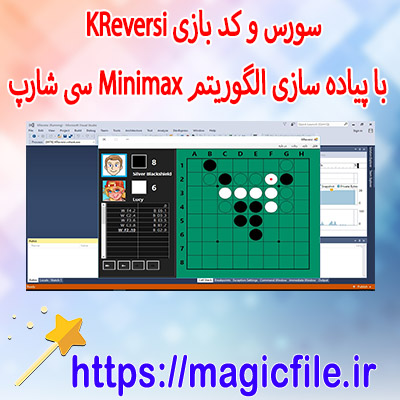
SOURCES CODE OF KReversi GAME WITH MINIMAX ALGORITHM IMPLEMENTATION AND A REVERSI BOT IN C#
When diving into the fascinating realm of game development, especially with classic board games like Reversi (also known as Othello), creating an intelligent, competitive AI opponent becomes an intriguing challenge. The project in question involves developing a comprehensive Reversi game in C# — complete with a graphical interface, a strategic AI opponent powered by the Minimax algorithm, and a well-structured source code foundation. Let’s explore this from the ground up, dissecting each component to understand how they synergize into a functional, engaging game.
- OVERVIEW OF THE REVERSI GAME IN C#
Reversi is a two-player game played on an 8x8 grid. Players take turns placing their disks—black or white—aiming to capture the opponent’s disks by flanking them horizontally, vertically, or diagonally. The game continues until neither player can make a move, and the winner is the one with the most disks on the board at the end.
Developing a game like KReversi in C# involves creating an intuitive graphical user interface (GUI), managing game logic, handling user interactions, and integrating AI logic. The source code is typically modular, with separate classes for the game board, players, AI, and utility functions.
2. STRUCTURE AND ARCHITECTURE OF THE SOURCE CODE
The core architecture generally comprises:
- Game Board Class: Manages the grid, tracks current state, and displays disks.
- Player Class: Manages human and AI players, handles move logic.
- AI Class: Implements the Minimax algorithm, evaluates game states.
- Main Program: Initializes the game, manages game flow, and handles user inputs.
This modular system promotes code clarity, easy debugging, and potential future enhancements, such as different difficulty levels or alternative AI strategies.
- IMPLEMENTATION OF THE MINIMAX ALGORITHM
At the heart of the AI component lies the Minimax algorithm—an intelligent decision-making process rooted in game theory. It systematically explores possible moves and their consequences, aiming to maximize the AI’s advantage while minimizing the opponent's.
In the context of Reversi, Minimax works as follows:
- Recursive Exploration: The algorithm simulates all possible moves up to a certain depth, considering both players’ turns.
- Evaluation Function: Each terminal state or depth-limited state is scored based on heuristics—such as disk count, mobility, corner control, etc.
- Backpropagation of Scores: The algorithm propagates these scores back up the recursion tree, choosing moves that lead to optimal outcomes for the AI.
- Alpha-Beta Pruning: To optimize performance, the algorithm often employs pruning, skipping branches that won’t influence the final decision, reducing computation time significantly.
The implementation demands careful coding to balance depth (for better intelligence) and speed (for real-time play). Usually, the evaluation function is customizable, enabling developers to tweak AI behavior.